
Agnus Dei - Lamb of God
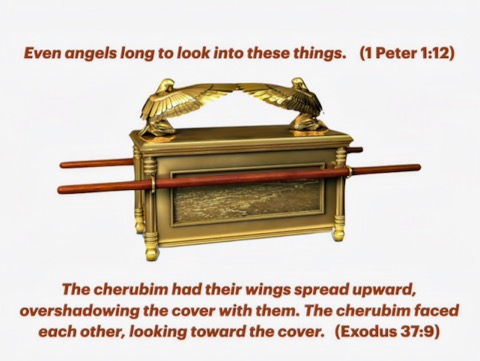
“Even angels long to look into these things.” (1 Peter 1:12) This verse has intrigued me for a lifetime. What do celestial creatures yearn to perceive and understand? What do angels lean down from heaven to ponder? What on earth attracts their attention? Angels are usually God’s messengers. But these are silent cherubim, guardians of God’s throne. They gaze with apparent wonder.
The context of 1 Peter is helpful. Old Covenant Prophets inquired about the specific details of God’s plan of salvation. Did terrestrial prophets and celestial messengers search out the same thing? When … Where … and How … would God’s plan be fulfilled?
Angelic pondering is also portrayed in some Exodus passages, that describe the construction details of a tabernacle. Where was the tent of meeting between the holy God and God’s sinful people?
He made a mercy seat of pure gold … he made two cherubim of gold … on the two ends of the mercy seat, one cherub on the one end, and one cherub on the other end. Of one piece with the mercy seat he made the cherubim on its two ends. The cherubim spread out their wings above, overshadowing the mercy seat with their wings, with their faces one to another; toward the mercy seat were the faces of the cherubim. (Exodus 37:6-8)
God gave Moses a detailed schema with the command to make everything according to the LORD’s precise pattern (Exodus 25:40). The earthly tabernacle in the wilderness was designed to be a copy or a shadow of realities in heaven (Hebrews 8:5).
Cherubim are angels who block sinful humans from direct access to the tree of life (Genesis 3:22-24). Mortals must not be doomed to live forever as broken, perishing, wanderers on earth. It is these flaming guardians who peer down on the ark of the covenant. “Above the ark … the cherubim of the Glory, overshadowing the atonement cover…” (Hebrews 9:5)
So God had a plan, though not yet fully disclosed. Mortals die as wanderers on earth. But the LORD would come down to earth to dwell with broken people. The tabernacle was the tent of meeting at the center of Israel’s families and tribes. Suggestively, Judah encamped on the east, toward the dawn of a promised new Day.
But access to God’s presence continued to be restricted. Only once a year, the representative high priest entered the holiest place. Inside a chest, the ark of the covenant, was God’s moral law. On the chest’s lid [atonement cover or mercy seat] the priest sprinkled the blood of a sacrificed lamb. It was on this cover that the cherubim gazed — where a lamb’s blood covered human transgressions.
The Sovereign rules in glory above. Blood Sacrifice is made below. “O LORD of hosts, God of Israel, enthroned above the cherubim, you are the God, you alone, of all the kingdoms of the earth; you have made heaven and earth.” (Isaiah 37:16)
Do winged cherubim look down on the mercy seat to shield their faces from God’s Glory? No, as the hymn says, “downward bends their wondering eye at mysteries so bright.” (1851, Matthew Bridges) One who came from above, even God’s own eternal Son, would be incarnate on earth to make final, full atonement for sinful people.
So the cherubim gaze in awe at this mystery. And also should we. With an incomprehensible love for sinners, God’s own Son was incarnate, tabernacled, pitched his tent among us, as Jesus Christ our perfect Kinsman-Redeemer. “Thanks be to God for his indescribable gift!” (2 Corinthians 9:15)
“Judgment against sin is preceded, accompanied, and followed by God’s mercy … The paradox of the cross demonstrates the victorious love of God for us at the same time that it shows forth his judgment upon sin … Jesus the Son of God does not just offer a sacrifice; he himself becomes the sacrifice because he offers up himself.” (Fleming Rutledge, The Crucifixion, p. 282)
Priest and Sacrifice became one and the same in God’s incarnate, crucified Son. As we enter Holy Week, and come to Good Friday, let us pause with angels and prophets to marvel at Agnus Dei. “Behold, the Lamb of God, who takes away the sin of the world!” (John 1:29)
The Spirituality of the Church
Does the spirituality of the church permit the silence of Christians?
I spent my adolescent years in 1960’s Mississippi. Members of theologically conservative churches often invoked “the spirituality of the church” to stay silent in the face of abhorrent societal sins like Jim Crow era racism.
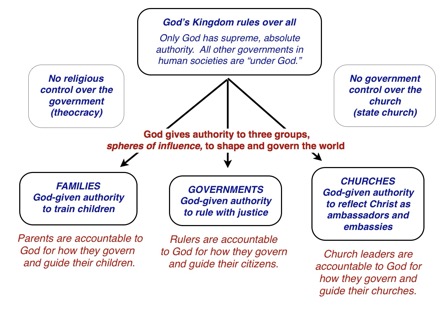
I myself believe in the doctrine of the church’s “spirituality.” But I do not believe in silent Christians. Jesus calls churches to be local embassies of God's kingdom, citizens of heaven (Philippians 3:20), entrusted by God with ministries of the Word, the Sacraments, and Prayer. So churches are not political entities with partisan agendas. There are followers of Jesus across the whole political spectrum. When churches do not wrap themselves in politics and ministers do not endorse politicians, it is not to preserve their tax-exempt status, but to stay faithful to their distinctive calling from God.
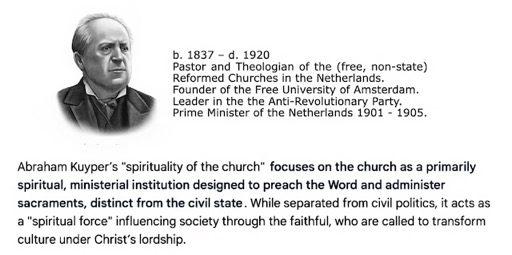
BUT … while churches are distinct from partisan parties, Jesus calls individual followers to influence and permeate society as preservative “salt” and truthful “light” (Matthew 5:13-14). If Jesus’ followers stay silent in the face of moral corruption and social decay, they become complicit. Christians, as John Stott observed, must remain “spiritually distinct, but not socially segregated.” Maintaining the church’s “spirituality” with Christian citizens’ “cultural engagement” was exemplified by the early 20th century Dutch Minister / Theologian / Prime Minister Abraham Kuyper.
Some examples of Christians who engaged in the political arena:
William Wilberforce (1759-1833) led the fight in the British Parliament to overturn the Slave Trade. He was influenced by two evangelical Anglicans, George Whitefield and John Newton, who urged him to stay engaged in the political fight to eliminate slavery.
American Patriot Patrick Henry (1736-99) was raised an Anglican, but was influenced by the Great Awakening and the Presbyterian evangelist Samuel Davies, one of the first non-Anglican preachers in Virginia. Henry credited Davies with inspiring his own oratory (“Give me liberty or give me death.”)
Dietrich Bonhoeffer (1906-45) warned the German state church about the political idolatry of the Nazi dictatorship. He argued that Christians should not retreat from the world but act within it. Bonhoeffer was martyred during the Nazi collapse.
Kuyper’s influence is evident in Ben Sasse, in recent interviews, as Sasse nears death from pancreatic cancer.