
Agnus Dei - Lamb of God
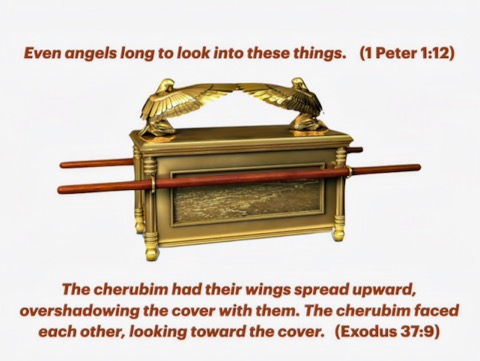
“Even angels long to look into these things.” (1 Peter 1:12) This verse has intrigued me for a lifetime. What do celestial creatures yearn to perceive and understand? What do angels lean down from heaven to ponder? What on earth attracts their attention? Angels are usually God’s messengers. But these are silent cherubim, guardians of God’s throne. They gaze with apparent wonder.
The context of 1 Peter is helpful. Old Covenant Prophets inquired about the specific details of God’s plan of salvation. Did terrestrial prophets and celestial messengers search out the same thing? When … Where … and How … would God’s plan be fulfilled?
Angelic pondering is also portrayed in some Exodus passages, that describe the construction details of a tabernacle. Where was the tent of meeting between the holy God and God’s sinful people?
He made a mercy seat of pure gold … he made two cherubim of gold … on the two ends of the mercy seat, one cherub on the one end, and one cherub on the other end. Of one piece with the mercy seat he made the cherubim on its two ends. The cherubim spread out their wings above, overshadowing the mercy seat with their wings, with their faces one to another; toward the mercy seat were the faces of the cherubim. (Exodus 37:6-8)
God gave Moses a detailed schema with the command to make everything according to the LORD’s precise pattern (Exodus 25:40). The earthly tabernacle in the wilderness was designed to be a copy or a shadow of realities in heaven (Hebrews 8:5).
Cherubim are angels who block sinful humans from direct access to the tree of life (Genesis 3:22-24). Mortals must not be doomed to live forever as broken, perishing, wanderers on earth. It is these flaming guardians who peer down on the ark of the covenant. “Above the ark … the cherubim of the Glory, overshadowing the atonement cover…” (Hebrews 9:5)
So God had a plan, though not yet fully disclosed. Mortals die as wanderers on earth. But the LORD would come down to earth to dwell with broken people. The tabernacle was the tent of meeting at the center of Israel’s families and tribes. Suggestively, Judah encamped on the east, toward the dawn of a promised new Day.
But access to God’s presence continued to be restricted. Only once a year, the representative high priest entered the holiest place. Inside a chest, the ark of the covenant, was God’s moral law. On the chest’s lid [atonement cover or mercy seat] the priest sprinkled the blood of a sacrificed lamb. It was on this cover that the cherubim gazed — where a lamb’s blood covered human transgressions.
The Sovereign rules in glory above. Blood Sacrifice is made below. “O LORD of hosts, God of Israel, enthroned above the cherubim, you are the God, you alone, of all the kingdoms of the earth; you have made heaven and earth.” (Isaiah 37:16)
Do winged cherubim look down on the mercy seat to shield their faces from God’s Glory? No, as the hymn says, “downward bends their wondering eye at mysteries so bright.” (1851, Matthew Bridges) One who came from above, even God’s own eternal Son, would be incarnate on earth to make final, full atonement for sinful people.
So the cherubim gaze in awe at this mystery. And also should we. With an incomprehensible love for sinners, God’s own Son was incarnate, tabernacled, pitched his tent among us, as Jesus Christ our perfect Kinsman-Redeemer. “Thanks be to God for his indescribable gift!” (2 Corinthians 9:15)
“Judgment against sin is preceded, accompanied, and followed by God’s mercy … The paradox of the cross demonstrates the victorious love of God for us at the same time that it shows forth his judgment upon sin … Jesus the Son of God does not just offer a sacrifice; he himself becomes the sacrifice because he offers up himself.” (Fleming Rutledge, The Crucifixion, p. 282)
Priest and Sacrifice became one and the same in God’s incarnate, crucified Son. As we enter Holy Week, and come to Good Friday, let us pause with angels and prophets to marvel at Agnus Dei. “Behold, the Lamb of God, who takes away the sin of the world!” (John 1:29)
The Spirituality of the Church
Does the spirituality of the church permit the silence of Christians?
I spent my adolescent years in 1960’s Mississippi. Members of theologically conservative churches often invoked “the spirituality of the church” to stay silent in the face of abhorrent societal sins like Jim Crow era racism.
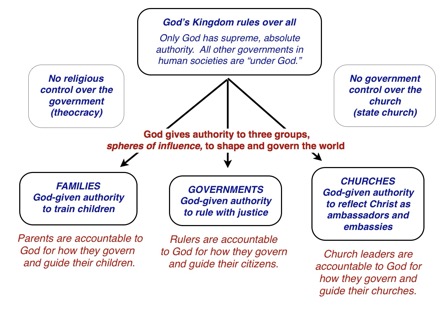
I myself believe in the doctrine of the church’s “spirituality.” But I do not believe in silent Christians. Jesus calls churches to be local embassies of God's kingdom, citizens of heaven (Philippians 3:20), entrusted by God with ministries of the Word, the Sacraments, and Prayer. So churches are not political entities with partisan agendas. There are followers of Jesus across the whole political spectrum. When churches do not wrap themselves in politics and ministers do not endorse politicians, it is not to preserve their tax-exempt status, but to stay faithful to their distinctive calling from God.
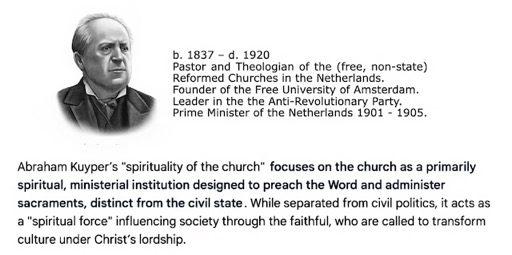
BUT … while churches are distinct from partisan parties, Jesus calls individual followers to influence and permeate society as preservative “salt” and truthful “light” (Matthew 5:13-14). If Jesus’ followers stay silent in the face of moral corruption and social decay, they become complicit. Christians, as John Stott observed, must remain “spiritually distinct, but not socially segregated.” Maintaining the church’s “spirituality” with Christian citizens’ “cultural engagement” was exemplified by the early 20th century Dutch Minister / Theologian / Prime Minister Abraham Kuyper.
Some examples of Christians who engaged in the political arena:
William Wilberforce (1759-1833) led the fight in the British Parliament to overturn the Slave Trade. He was influenced by two evangelical Anglicans, George Whitefield and John Newton, who urged him to stay engaged in the political fight to eliminate slavery.
American Patriot Patrick Henry (1736-99) was raised an Anglican, but was influenced by the Great Awakening and the Presbyterian evangelist Samuel Davies, one of the first non-Anglican preachers in Virginia. Henry credited Davies with inspiring his own oratory (“Give me liberty or give me death.”)
Dietrich Bonhoeffer (1906-45) warned the German state church about the political idolatry of the Nazi dictatorship. He argued that Christians should not retreat from the world but act within it. Bonhoeffer was martyred during the Nazi collapse.
Kuyper’s influence is evident in Ben Sasse, in recent interviews, as Sasse nears death from pancreatic cancer.
Your Brand or Your Reputation?

What do you want — a personal BRAND, or a good REPUTATION?
We live in a time of Influencers who seek Followers, but there are not enough servant Leaders. Influencers build a personal BRAND, but Leaders want a good REPUTATION. Influencers seek a Platform. Leaders choose a Posture. You build a BRAND for yourself. But a REPUTATION is received from others. This distinction is important if you want a good Name that will last beyond social media clicks, spaces of influence, and even beyond your own lifetime.
The gold standard for REPUTATION is found in Philippians 2:1-11. Here is the One who did not cling to high position, his essential equality with God the Father, or his high status, but served others with great personal self-sacrifice, and all for the glory of God. So, “God exalted him to the highest place and gave him the Name above every Name” to everlasting and universal acclaim. Jesus earned a well-deserved REPUTATION for nobility with a legacy of glory because of his humble, self-giving, costly sacrificial service.
God’s Son emptied himself of self to love others. He neither thought less of, nor more highly of himself than he truly deserved. Jesus Christ lived selflessly in the service of his Father’s glory, and the good of others.
By contrast, a BRAND name is not the same as a good REPUTATION. Recall how Mr. Trump said: “You’ve got to put your name on stuff or no one remembers you.” An obsession to build a personal BRAND is why we get Trump Steaks, Trump Accounts, Trump Gold Cards, Trump Rx, Trump Mobile Phones, Trump Center for the Arts, Trump Institute for Peace, Trump Towers, Trump Golden Fleet, Trump Bibles, Trump Casinos, Trump Resorts, Trump Bitcoin, Trump University, Trump Sneakers, Trump Hotels, Trump Golf Resorts.
BRANDS, even gilded and profitable ones, have a short shelf life and often go bankrupt. But a good REPUTATION will endure. “A good name is to be chosen rather than great riches, and favor is better than silver or gold.” (Proverbs 22:1)
The contrast between a BRAND and a REPUTATION is often observed in the behaviors of the “old money” aristocracy and the “new money.” Those with a secure identity can give of themselves, personally and sacrificially, to benefit the lives of others. But nouveau riche are often insecure. So they inflate themselves to project their own self-importance, and often demean the reputations of other people.
Every follower of Jesus has a God-given mandate: “Have this mindset among yourselves, which is yours in Christ Jesus.” (Philippians 2:6) Those who follow and serve God in imperfect imitation of Jesus’ cruciform way of life will receive a legacy that lasts. “Blessed are the dead who die in the Lord from now on. Yes, says the Spirit, they will rest from their labor, for their deeds will follow them.” (Revelation 14:13)
This New Year,
Are you building your BRAND?
Or choosing a good REPUTATION?
A PCA Great Omission?
The Presbyterian Church in America's 2024 national meeting saw detailed deliberations over its Rules of Operations, who may distribute the elements of the Lord’s Supper, who may serve on church committees, and procedures for discipline. But a weightier matter was shelved.
The 52nd PCA General Assembly voted to indefinitely postpone Overture #50 from Chesapeake Presbytery: Encouragement to Discernment and Compassion regarding Immigrants — click to read. The vote was 706 yea / 476 nay. *With charity toward all the commissioners, I have learned (since I was not present) that Overture #50 was received late, and was the last to be docketed. The indefinite postponement may have been due to parliamentary fatigue.
I have taught and preached on Biblical hospitality for decades. Recently, this online resource. I developed and led the PCA's hospitality-based ministry for international students, one of only two denomination sponsored international student ministries. So I am compelled to offer a gentle, respectful, but firm and insistent reminder to fellow PCA Elders.
Churches can only indefinitely postpone the practice of Biblical hospitality (filoxenia: redemptive, family love for strangers and foreigners) until the great Day when all opportunities to welcome and receive the Lord Jesus will be gone … forever.
Lord, when did we see you? (Matthew 25:35)
We are commanded to both practice hospitality (Romans 12:13) and honor the emperor (1 Peter 2:17). We can support immigration reforms without being callous to asylum seekers, refugees, or legal immigrants. We can care for our legal guests, like international students and scholars (fully screened and granted legal F- and J- visas).
Our politics (left, right, or center) must never control or corrupt our fidelity to God’s Word (Hebrews 13:2, Genesis 18:1-15). We were all once foreigners, but we are now, by God's grace, citizens of God’s Kingdom (Philippians 3:20-21).
The postponed Overture #50 seeks to encourage Gospel obedience: “The PCA encourages its churches to speak and act toward the sojourner in ways shaped not by political rhetoric but by the gospel, remembering our own identity as once-strangers, now brought near by grace.” (Ephesians 2:13)
Jesus, God’s ultimate resident-foreigner, stands knocking on our church doors. (Revelation 3:20). We must not close our ears to his voice because we are consumed by worldly media or political ideology. We must not harden our hearts to the gospel.
Jesus came as our Kinsman-Redeemer. (John 1:11-12) We cannot claim to fully obey our Lord's "Great Commission" if Christian hospitality becomes our "Great Omission," indefinitely postponed until Jesus Christ returns in glory.
A Renewed Opportunity
The PCA's next General Assembly is in June 2026, in Louisville, KY. The host committee has announced the theme for the week: “The Welcome of God.” My prayer: that our Welcoming God will make the PCA an increasingly Welcoming People.
American Idolatry (part 5)

GOD'S EXILES BLESS BABYLON.
Civil Religion tries to enlist religion and the church to support the State’s agenda, but Public Theology urges God’s people to return to God’s Word, and then sends them into the public square to pursue the common good of all society — not just your own religious tribe. I treasure a gift from Chinese students in the USA — an object of calligraphy that may be translated, Honor God and Bless People — a good summary of the Great Commandments and Public Theology!
God expelled the people of Israel from their land because they were unfaithful, serving idols. Deported to Babylon, they were told to not be nostalgic for their failed theocracy, but repent of their idolatry, then bless the pagan empire, Babylon. Repent > Be Refined > Bless.
This is the way forward for American Christians and churches. We must first recognize the bad consequences of our trust in politicians. The path ahead is not to go back to some golden age. We must rediscover our identity as God's foreigners. To invert an old phrase, we must learn to live as a moral minority in a foreign land. Or, in John Stott's words: to be spiritually distinct, but not socially segregated. Only when Jesus’ followers and church are spiritually distinct, salt and light, can we bless our nation.
David Brooks, who converted to Christ from Judaism, has noted that the Jews in Babylon are the only case when a people retained and did not lose its cultural-religious distinctives through assimilation. Only the people who belong to God, and who live as God's foreigners, will bless the world. To learn to live as Exiles, God’s people have guidance from God's Word, the Bible. Three examples:
From the Old Testament: Jeremiah’s letter to the Jewish Exiles: Thus says the LORD of hosts, the God of Israel, to all the exiles whom I have sent into exile from Jerusalem to Babylon: Build houses and live in them; plant gardens and eat their produce. Take wives and have sons and daughters; take wives for your sons … give your daughters in marriage, that they may bear sons and daughters; multiply there, and do not decrease. But seek the welfare [Shalom, complete well being] of the city where I have sent you into exile … pray to the LORD on its behalf, for in its welfare [Shalom] you will find your welfare [Shalom]. (Jeremiah 29:4-7)
From the New Testament: the Apostle Paul to the Philippians: our citizenship is in heaven, and from it we await a Savior, the Lord Jesus Christ (Philippians 3:20). The cultural context: Philippi was a colony of Rome in the heart of Greek Macedonia. But, rather than exercise their rights and social status as Roman citizens, they must do nothing from selfish ambition or conceit, but in humility count others more significant than yourselves. Let each of you look not only to his own interests, but also to the interests of others. Have this mind … which is yours in Christ Jesus … (Philippians 2:3-5)
Again, from the New Testament: the Apostle Peter writes to Christians in Asia Minor, a power center of the Caesar cult: to those who are elect exiles of the Dispersion in Pontus, Galatia, Cappadocia, Asia, and Bithynia … I urge you as sojourners and exiles to abstain from the passions of the flesh … Keep your conduct among the Gentiles honorable, so that when they speak against you as evildoers, they may see your good deeds and glorify God on the day of visitation. (1:1, 2:11-12).
Like the Jews in imperial Babylon, or the early Christians under imperial Rome, American Christians now live under an authoritarian regime. Journalist David French notes that this is typical in history, but we live in one of the few times when Christians democratically voted themselves for such a regime (the 1930’s “good Germans” also come to mind). When we confess and follow Jesus Christ under the thumb of a Caesar in a decaying empire, that is the more typical historical norm.
Now, if we live in such circumstances and serve counter-culturally (protecting unwanted lives, redeeming and not disposing of them, or welcoming foreigners to take refuge in our embassies), we may be maligned as “backward conservatives” or “woke progressives.” But, in truth, we will become glimpses of the Kingdom of God, a new world coming, filled with righteousness and peace and joy in the Holy Spirit. (Romans 14:17)
From his distant vantage point in North Africa, Augustine witnessed the decline and fall of the Western Roman Empire. The “eternal city” on earth was overrun and sacked by the Visigoths in AD 410. But Augustine also glimpsed and wrote about the true Eternal City, The City of God.
Now, as 80 years of a Pax Americana degenerates to an inevitable end, may the good news of God’s Kingdom spread rapidly through the lives of people who live as Jesus Christ's Ambassadors, and through local churches that serve their communities as Embassies of God’s Kingdom — the only Empire that cannot be shaken!